Sunday, December 19, 2010

The Red Fort


 (Right from Wikipedia...)

The Red Fort is a 17th century fort complex constructed by the Mughal emperor Shah Jahan in the walled city of Old Delhi (in present day Delhi). At one point in time, more than 3,000 people lived within the premises of the Delhi Fort complex.  It served as the capital of the Mughals until 1857, when Mughal emperor Bahadur Shah Zafar was exiled by the British Indian government. The British used it as a military camp until India was made independent in 1947. It is now a popular tourist site, as well as a powerful symbol of India's sovereignty: the Prime Minister of India raises the flag of India on the ramparts of the Lahori Gate of the fort complex every year on Independence Day.  It was designated a UNESCO World Heritage Site in 2007.

(Any text italicized below came from Wikipedia as well or from Archeological Survey of India website.)


The driver dropped us off, including our faithful took-took driver turned guide Harish, at the entrance of the Red Fort where we were immediately pounced on by touts of all ages trying to sell us everything from postcards to tiny plastic took-tooks.  Thankfully we go through a security gate right away where the touts are left behind and we can breathe easy. 

We paid for Harish to accompany us inside the Fort.  His entrance fee was 15 rupees (.33 cents) while we were 750 rupees ($16.66 USD). 

After going through the typical Indian security (men and women separated, everything searched, body pat-downs) you come to Lahori Gate - the main entrance into the Red Fort.


Lahori Gate leads you to Chatta Chowk, a long covered bazaar "street" which is now basically just a bunch of stalls selling touristy stuff.  But the design of this vaulted arcade is quite striking in a very simple way.


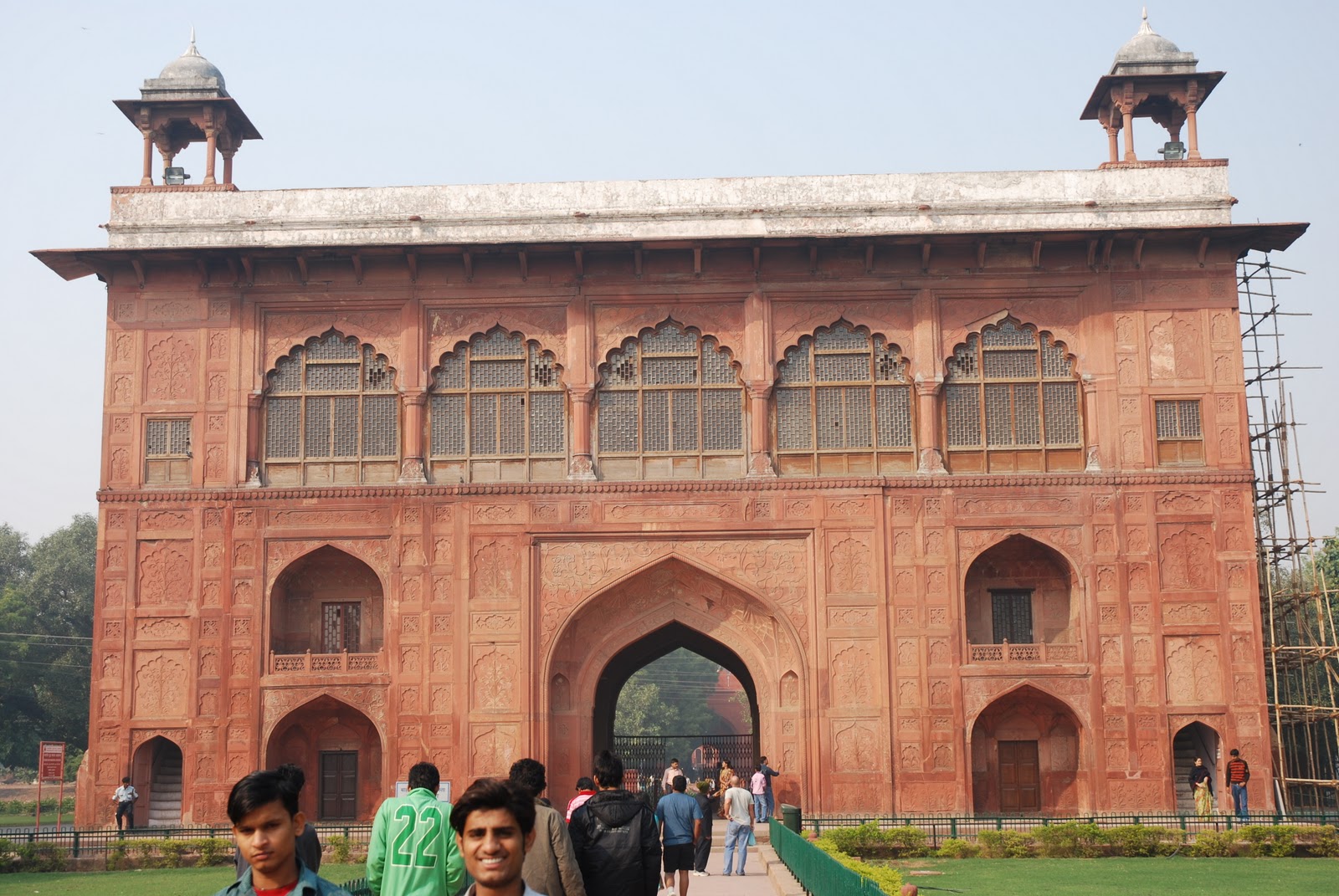
The Chatta Chowk leads to Naqqar-Khana (Drum-house), where ceremonial music was played and which also served as the entrance to the Diwan-i-'Am (explained below). Its upper story is now occupied by the Indian War Memorial Museum.  Honestly, I found the museum boring, although I did find it amusing to see Indian tourists taking photos of us.  And quite openly... they didn't hide the fact they were snapping photos of us white folk.


Take a closer look at the scaffolding... OSHA would have a field day with this...


From this gate you come to a large open area which once served as the courtyard for the Diwan-i-'Am - the building where the emperor would come out on his big throne and speak to his subjects.  Below is the throne.


The Diwan-i-' Am (Hall of Public Audience) is yet another amazing structure that is still standing after all these centuries later.  It is a "rectangular hall, three aisle deep, with a façade of nine arches. At the back of the hall is an alcove, where the royal throne stood under a marble canopy."


G in front of a neat looking tree:


There are several other buildings of importance, but I don't want to bore anyone with too many photos, so I'll mention one last building - the imperial private apartments.  These "apartments" consist of a row of pavilions connected by a continuous water channel, known as the Nahr-i-Behisht (Stream of Paradise).  The water is drawn from the river Yamuna, from a tower, the Shah Burj, at the north-eastern corner of the fort. The palace is designed as an imitation of paradise as it is described in the Koran; a couplet repeatedly inscribed in the palace reads, "If there be a paradise on earth, it is here, it is here". 


When we left the Red Fort we were once again mobbed by touts.  One followed us all the way to the car... which was quite a hike away and we would not have found it easily if it weren't for Harish. 

Sunday, December 12, 2010

Harish & on the way to the Red Fort

Our first day in Delhi when we needed to go clothes shopping for G we flagged down a took-took (auto rickshaw) and our driver was Harish.  We liked Harish.  He spoke good English, was friendly and helpful.  After having difficulties getting a car that evening for the engagement ceremony and the next morning for the wedding we gave up on our hotel helping us out with this.  We wanted an AC car for our whirl-wind tour of Delhi on Saturday.  It was too far and too long of a time to spend the day on took-took.  The fumes in Delhi are a bit potent, especially on a took-took only one foot from some other vehicles tail pipe.  Most of the time we spent taking a took-took we had to cover our nose and mouth to block some of the noxious fumes.


So, as we were driving to get dinner on Friday night we decided we would call Harish and see if he could hook us up with a car and driver.  It turns out that our took-took driver to dinner is friends with Harish, so he called him for us.  We agreed on a price for 7 hours, an AC car, a driver that spoke a little English, and our pickup time.

Based on my research, I was prepared to pay up to $50 for the day for an AC car and driver.  When Harish told us 900 rupees ($20 USD) for the day I was shocked and quickly told Chris to accept his offer without negotiation.

Saturday at 9am Harish shows up at our hotel with a car and driver.  After some slight confusion on our part we realized that Harish was coming along with us at "no charge" because he too is "friend of Krishna."  (My tip to you:  wear neck beads to India, even if you aren't even close to being Hindu, it turns out they can work in your favor, even in the most bizarre of circumstances.)

So the reason Harish was coming along with us was because he didn't own the car, but his friend who was driving us was the owner but didn't speak English at all.  So Harish was coming along as our sort of guide.  We were actually quite happy with this situation and it turned out to be a huge help that he was with us  Which I'll get into with the next post about the Red Fort.  And how we insisted on paying more than just $20.

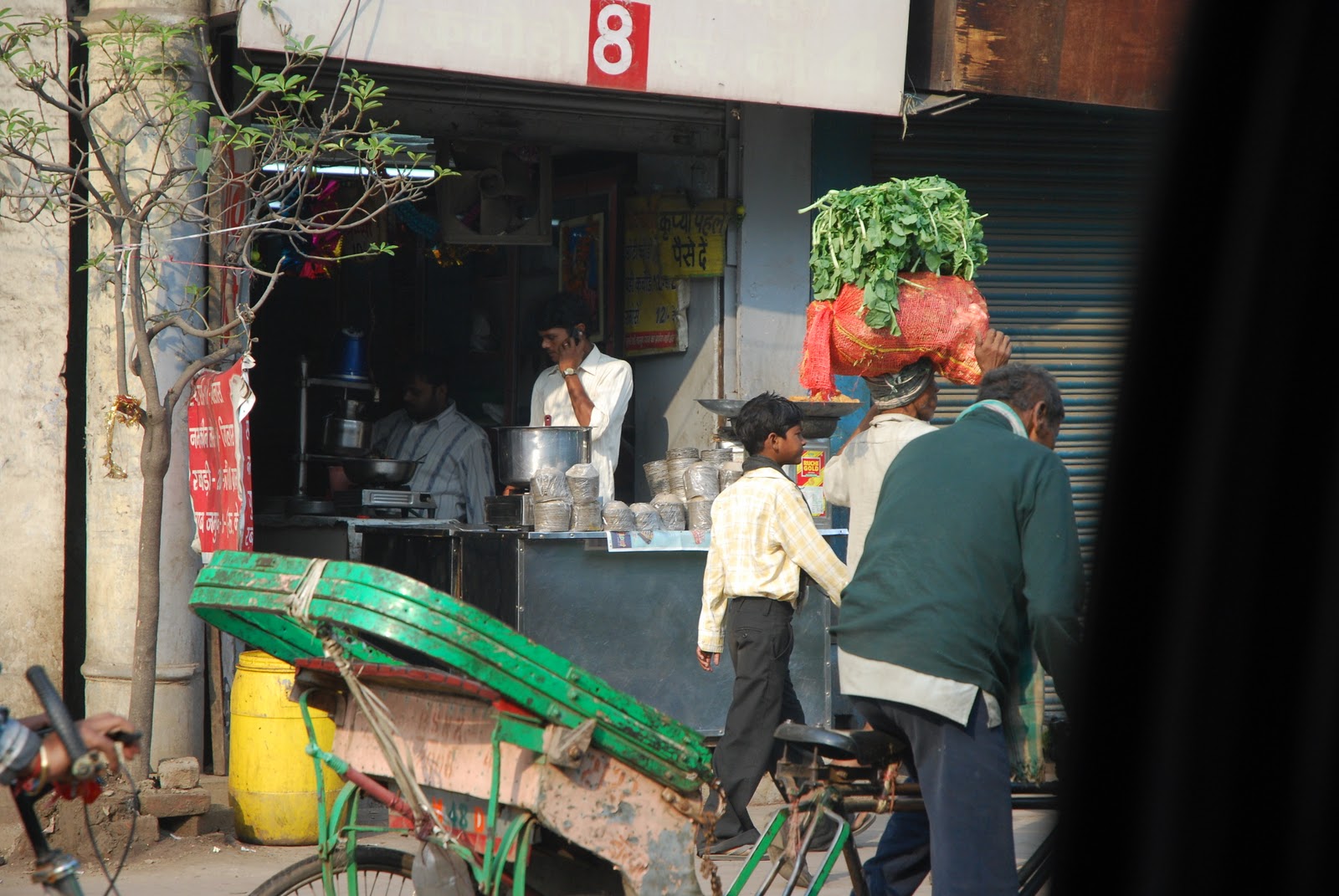
Random photos on the drive to the Red Fort:


Wednesday, December 8, 2010

Indian Take Out

The day of the wedding we napped for 3 hours after returning to the hotel.  We didn't get to eat any lunch, so when we woke up at 4pm we were starving.  We took an auto rickshaw to Haldiram to get some grub and it turned out it is not a sit down restaurant.  (Even with all my research, quite a few things in India turned out not to be what I thought.  Lost in translation, I suppose.) 

Haldiram is a take out place with a few standing only high top tables to eat there.  It was very crowded, looked modern and clean, and there was a security guard out front.  All good signs that it's a good place to get food from.

It was a bit confusing at first figuring out how and where to order, and then we had to wait 10 minutes for 5pm to arrive so that we could order the South Indian Platter.  It was worth the wait.

So we got our Indian take out, took our waiting rickshaw back to the hotel and enjoyed some very tasty dosas, idlis and some pizza-like thing.  G found the dosa too spicy but was happy with rice and dahl. 

This may be hard to believe, but this was one of the best meals we had in India.  We got 2 South Indian Platters (as seen below), one order of masala dosa, an order of dalh and rice, and 2 waters.  Our total, with 12.50% tax, was 576 rupees ($12.80 USD).  And we couldn't finish all of it.


G eating an idli, which she surprisingly doesn't care for.  Although she won't use it to scoop up anything, so by itself it is rather bland.

Sunday, December 5, 2010

Shopping in Delhi - Our Wool Peacock Rug

Besides shopping for clothes, I had my heart set on purchasing a rug to use as a wall hanging.  The first place we looked into rugs was at a government emporium, which means that the price is set and there is no bargaining.  Although we have our doubts about that policy.  Anyway, at the first place we received a very interesting and educational lesson on how rugs are made, how long they take to make, and the various silk and wool used.


The price quoted to us here for a small rug was more than we wanted to spend.  So we walked.  But we at least had a ball park figure for what this thing was going to cost.  We visited a second government emporium and received about the same price, but for a rug I didn't like quite as much as the first one. 

At this point we insisted our driver take us to a non-government store where we could negotiate the price.  The problem with this is that drivers get a kick back from the government run shops for bringing you there.  As do some of the bigger non-government shops, but the kick back isn't as high, depending on how low you negotiate the price to.  So you can see why drivers push you towards these government shops.  We made it very clear to our driver, Harish (who was actually a cool guy and we really liked him, even if he was trying to rip us off occasionally, which I'll talk about him in my next post), that we would compensate him adequately for taking us to a place we could negotiate. 

So we finally ended up at Nirula Handicrafts Bazarn in Gole Market.  They had rugs galore.


We had decided earlier we liked the peacock motif, rather than an abstract design.  And we knew we did not want to spend the money on silk, although they are very shiny, soft and pretty, but out of our price range for something we planned to hang on the wall.  Below is a lovely round peacock rug in silk, which was gorgeous (the photo doesn't do it justice), but we couldn't even begin to negotiate this one down to our price.


So on to this equally beautiful peacock design in wool.


And from here the negotiations commenced.  Chris and the salesman went back and forth with a calculator.  The clerk wouldn't meet our highest price so we said "thanks for your time" and got up to leave.  At which point he gave us some spiel about liking us, yadda yadda, and he would go lower than he should and give it to us at our final price.  Chris was so darn proud of himself.  He talked the salesman down 4,500 rupees from his original quote.  (That's $100 USD!)  Although the original quote here was 2,250 rupees higher than the government emporiums prices.  So I am glad we went to the government shops first so we had a general idea of what the price really was, which we used as a bargaining tool - "Nine thousand rupees!  The government emporium quoted us 6,750 rupees for the same rug.  We'll just go back there."  "No sir, please, we will work with you.  Here is a calculator, show me the price you want to pay."  Chris was in his bargaining glory.

My concern was getting this thing home without damaging it.  Turns out they pack up quite small and when folded the correct way it won't be damaged at all.  It gets folded the correct way, then wrapped in blue plastic, then a grain bag-like material stitched around it along with a handle.  They label it with your name and "flying carpet."


Our new beautiful wall hanging is currently laid out in the garage where it was being de-bugged (another long story, although it didn't really have bugs, as far as I know...) and now awaits for us to get it mounted on the wall in the living room.  I know every time I look at it I will remember our amazing adventures in India.  And Chris will probably only remember his amazing negotiation skills.  :-)

Thursday, December 2, 2010

ISKCON New Delhi


Most tourist and religious places in Delhi don't mess around with security, which I don't mind at all.  I'd rather be patted down and have my bag thoroughly searched rather than be more vulnerable to crazy people who want to bomb everything and everyone.  The ISKCON temple was no exception.

Men and women have separate search lines, where the women are taken behind a curtain to be patted down and searched.  I was even asked to demonstrate that my camera was an actual functioning camera.  Chris had his pocket knife confiscated, obviously.  He forgot he had it in his pack.  Why did he bring a pocket knife to India, you may ask; in case we needed to peel and cut fruit, cut off tags, etc.  We packed it in the checked luggage while flying.  We thought for sure the knife was a goner, but on the way out of the complex he stopped in at security and they actually gave it back to him.

The main area overlooks this statue of Krishna and the serpent Kaliya.  The story is that Kaliya made its home in the Yamuna and because it was poisonous all the fish died.  The vegetation along the river died as well, along with any birds that flew over the water.  Krishna jumped in the Yamuna, the serpent grabbed hold of him, Krishna made his body grow so that Kaliya had to release him.  Krishna then jumped on the serpent's many heads and began dancing and eventually Kaliya left and never returned.


There were quite a few people inside the temple waiting for the deity doors to open.  A security guard appeared and gated off an area between the main altar and the people.  I thought this was interesting... perhaps there has been issues of people getting too close to the deities?  Finally the doors opened and everyone crowded forward, offering obeisances and garlands and taking photos.


Modes of transportation in the temple parking lot.


Wednesday, December 1, 2010

Lotus Temple

The Bahá'í House of Worship in Delhi, also known as the Lotus Temple, is an amazing structure.


About the religion:
The Bahá'í Faith is a world religion whose purpose is to unite all races and peoples in one universal Cause and one common Faith.  Bahá’is are the followers of Bahá’u’lláh, Who they believe is the Promised One of all Ages. The traditions of almost every people include the promise of a future when peace and harmony will be established on earth and humankind will live in prosperity. We believe that the promised hour has come and that Bahá’u’lláh is the great Personage Whose teachings will enable humanity to build a new world.

About the structure:
Since its inauguration to public worship and visits in December 1986, the Bahá’í House of Worship in New Delhi, India has drawn to its portals more than 70 million visitors, making it one of the most visited edifices in the world. On an average, 8,000 to 10,000 people visit the Bahá’í House of Worship each day. These visitors have admired its universal design in the form of a lotus.

For more information on why  it's a lotus, etc., you can read about it on the Bahá'í House of Worship website.


The inside is simple, yet still amazing.  Unfortunately no photography is permitted inside.


Views from the Lotus Temple:


(ISKCON New Delhi Temple above)